Fabric RLM: Why Harness Matters
Principal Program Manager, Microsoft Fabric CAT helping users and organizations build scalable, insightful, secure solutions. Blogs, opinions are my own and do not represent my employer.
In my previous blog I introduced Fabric-RLM and an overview of how it works. Let me illustrate with a simple example how giving a model a harness to work with helps.
Question : How many days of the week have the letter d in them?
Of course, the answer is 7. I asked nine small and mid-size models from OpenAI, Mistral, Google and Qwen. Eight of them got it wrong. Then I asked the same nine models the same question through Fabric-RLM. All nine got it right.
The model didn't change but the way model was used changed.
| Model | Direct | Fabric-RLM |
|---|---|---|
| openai/gpt-4o-mini | 2 ❌ | 7 ✅ |
| openai/gpt-4.1-mini | 2 ❌ | 7 ✅ |
| openai/gpt-4.1-nano | 2 ❌ | 7 ✅ |
| mistralai/mistral-small-24b | 3 ❌ | 7 ✅ |
| mistralai/ministral-3b | 3 ❌ | 7 ✅ |
| mistralai/ministral-8b | 4 ❌ | 7 ✅ |
| google/gemini-2.5-flash-lite | 2 ❌ | 7 ✅ |
| qwen/qwen-2.5-7b-instruct | 5 ❌ | 7 ✅ |
| qwen/qwen3-8b | 7 ✅ | 7 ✅ |
| Correct | 1/9 | 9/9 |
Before you say these are old models, here is gpt-5.6-sol :D
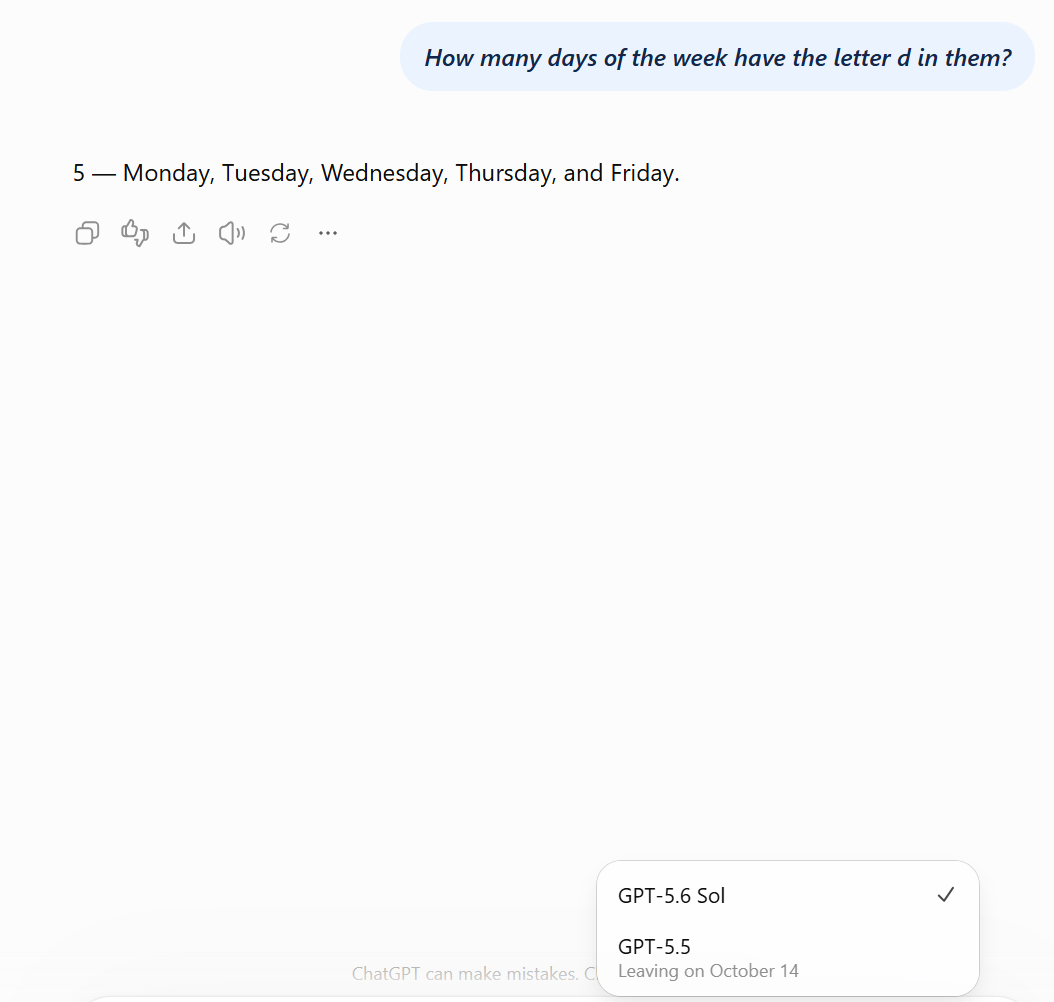
Why models get this wrong
LLMs don't read letters, they read tokens. "Monday" is one or two tokens, not six characters. So when you ask whether a word contains a d, the model is guessing from what it has learned about the token, not counting letters. It is a blind spot of how the model sees text, not a lack of knowledge.
How Fabric-RLM got to the answer
Fabric-RLM doesn't give the model any extra knowledge. It gives it a place to work: a Python workspace, and a loop where it can run code, look at the output, and submit an answer only when it's ready.
Here is what gpt-4o-mini did with Fabric-RLM
import os
import dspy
from fabric_rlm import RLM

lm = dspy.LM(
    "openrouter/openai/gpt-4o-mini",
    api_key="sk-<>",
    api_base="https://openrouter.ai/api/v1",
    temperature=0.0,
)

result = RLM.task(
    task="How many days of the week have the letter d in them?",
    outputs={"answer": int},
    lm=lm,
    max_turns=6,
).run()

print(result.payload)          # {'answer': 7}
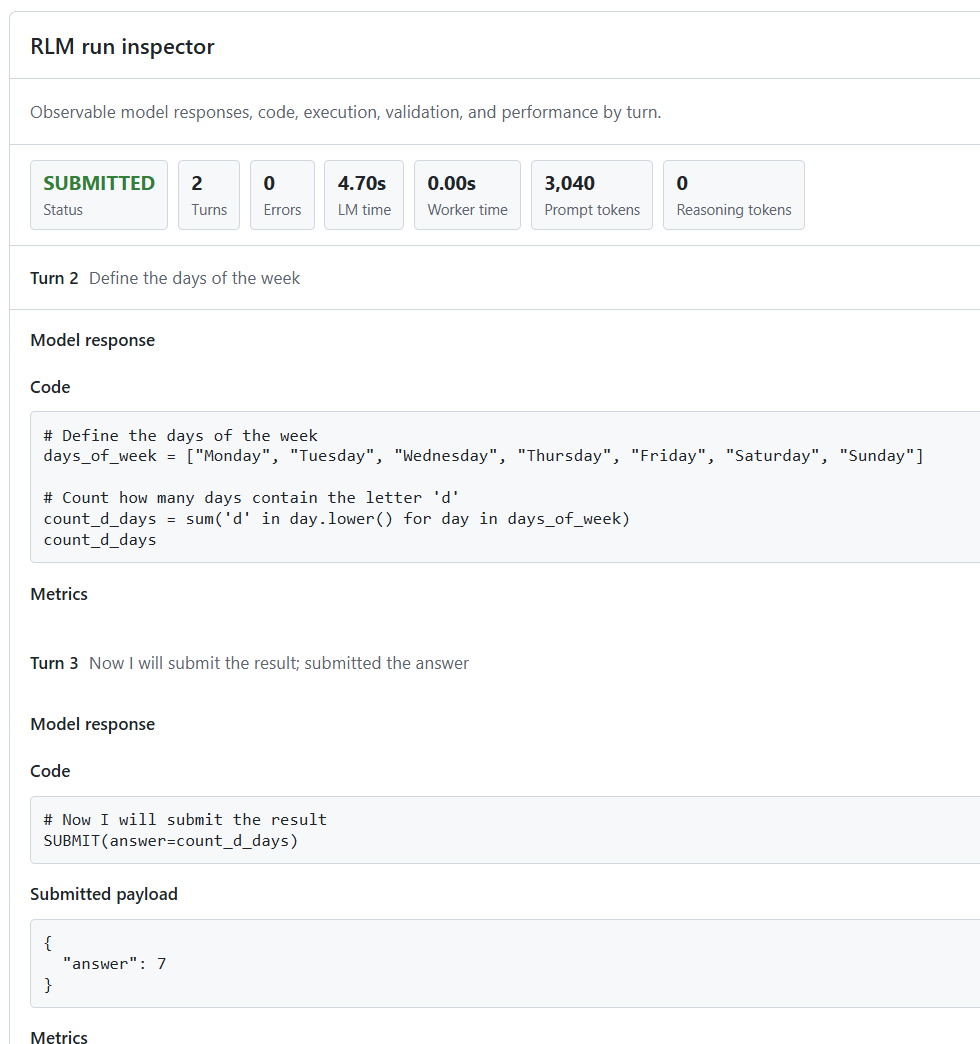
Fabric-RLM solved it in two turns. First, it wrote down the names of the days in a list and then wrote the Python code to find days with 'd' in them. Same input, same model different harness.
This doesn't mean Fabric-RLM can be used for all tasks. If you ask Fabric-RLM to write a joke, it can't count, filter, compute etc so it's not the right harness this task.
Harness here is the context, tools, guardrails, skills, compute etc the model has to complete the task.